News
Written by
Ambience Healthcare
Read time
4
min read
Posted on

In Part 1, we argued that better models alone will not close the million miles between AI and better care. That distance requires infrastructure, and we introduced Ambience Chorus as the shared AI infrastructure that powers every Ambience product. We began with its system of context: a continuously updated, source-linked understanding of the patient that every capability reads from, so no clinician and no product works from a partial or stale picture.
Understanding the patient is only half the job. A clinician who reads the whole chart and stops there has not helped the patient yet. The same is true of AI. Intelligence that cannot act has reduced impact on patient care and the system.
This post covers the second half: the system of action that puts that understanding to work inside clinical workflows.
Clinical actions
A clinician’s day involves gathering and reviewing information, deciding what to do next, and carrying those decisions into the record and care plan. Across that workflow, a clinical action is concrete work Chorus performs to help the clinician move a patient’s care forward.
Context is the ability to understand a given patient completely. Action is how Chorus applies that understanding in the clinician’s workflow. Some actions help a clinician prepare and decide: assembling the relevant history before a visit, summarizing the chart for this clinician and this patient, and surfacing what has changed, what conflicts, and what is missing. Other actions help carry out decisions: writing the note, adding to the problem list, queuing the visit diagnosis, suggesting E&M and other codes, writing patient instructions, and pending orders for signature. In each case, Chorus takes on work the clinician would otherwise do, preparing it for review or making the next step one click away.
The system of action is the infrastructure within Chorus that makes this work possible. It uses the full patient context, together with the clinician’s interactions and guidance, to perform work within the EHR. Sometimes the result is a suggested next step. Sometimes it is a change prepared in the chart and waiting for a signature. In every case the clinician is in the loop. Acting without context or boundaries is automation of mistakes. A governed system of action prevents that.
What a system of action has to do
1. Act within the encounter
One clinician, one patient, one encounter. While the chart is open and the clinician is deciding, Chorus shows the next best action, cites the relevant encounter context and clinical guidelines, and reduces the work to one click. Real time is the requirement. A suggestion that arrives after the visit is a task. To arrive during the visit, Chorus sits inside the EHR where the clinician already works, placed for each care setting so the clinician never has to go looking for it.
Before the visit, Chorus prepares the relevant history and likely next steps and keeps that pre-visit picture consistent with what happens in the room. During the visit, Chorus writes the note as the clinician would write it and suggests diagnoses and codes. After the visit, Chorus pends orders, instructions, and problem list updates for signature. For example, Patient Summary flags an open care gap against current guidelines, and Care Gap Advisor pends the order for the clinician to sign.
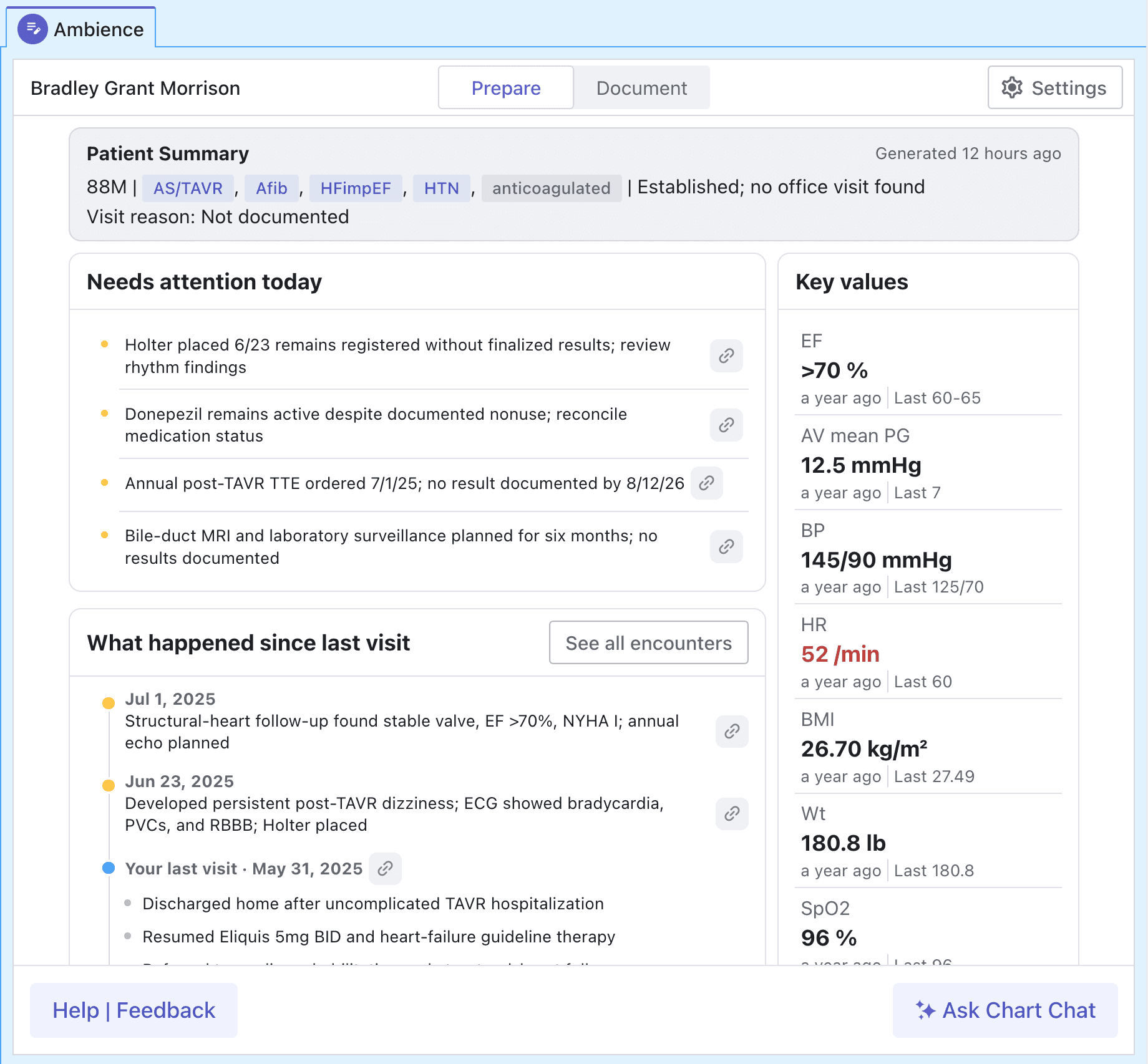
One decision often changes several places in the chart. When an acute condition that required medication resolves, the encounter diagnosis, the problem list, and the medication list all need updates. Chorus coordinates those writes, checks each one, verifies the final state is consistent, and shows the clinician any discrepancy rather than writing it silently.
2. Act across workflows
Care is a team sport: primary care and specialists, hospitalists and nurses, clinicians and coding teams. An action taken in one clinician’s workflow changes what every other clinician sees in theirs.
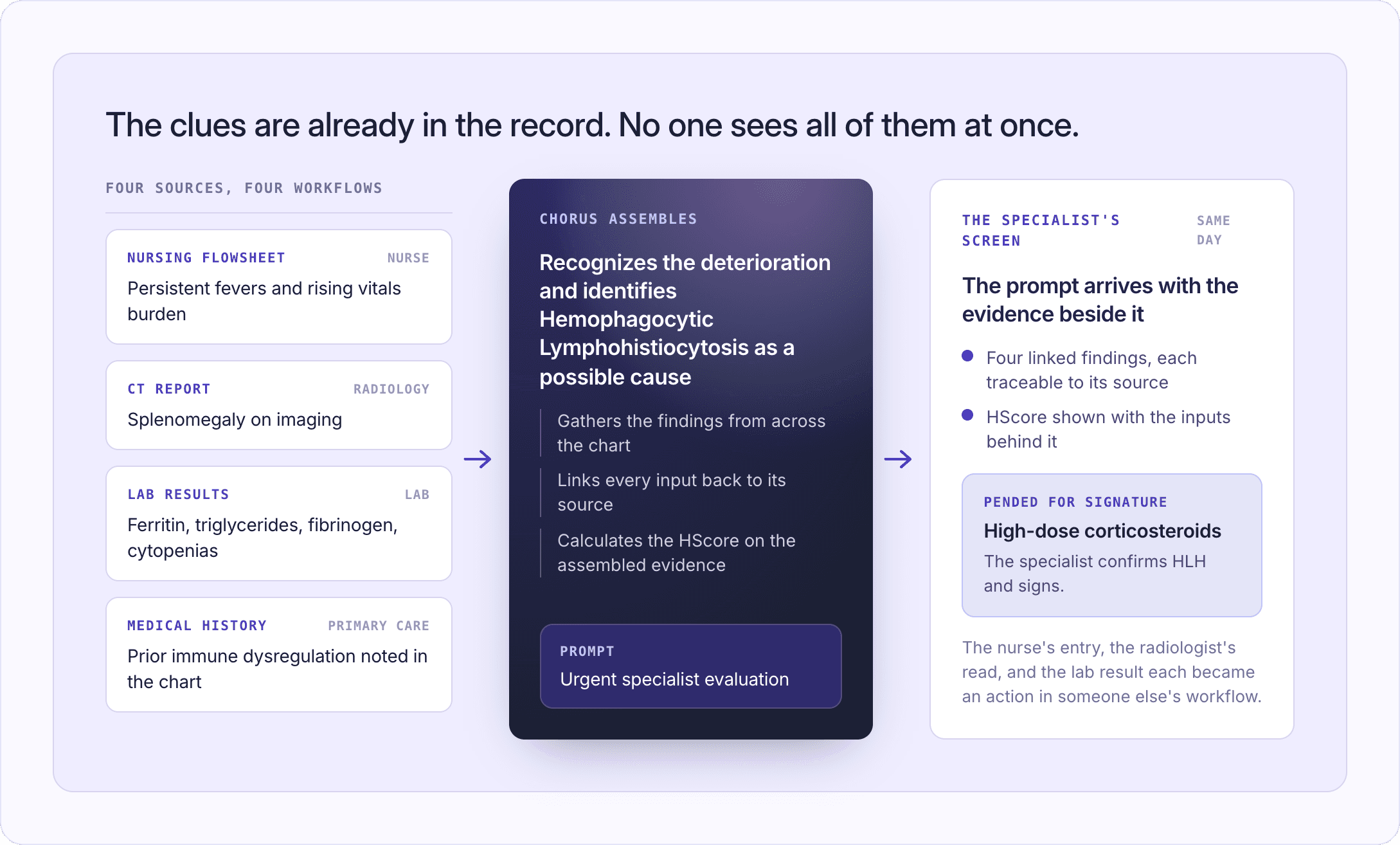
An admitted patient is deteriorating despite treatment for sepsis. The clues that point to hemophagocytic lymphohistiocytosis (HLH), a potentially fatal inflammatory syndrome, are already in the record, but they sit in different places: nursing flowsheets, a CT report, lab results, and the medical history. No single member of the care team sees all of them at once. The hospitalist asks Chorus what is happening. Chorus reads the chart, builds a differential that includes HLH, recognizes that the HScore applies, pulls the inputs from across the record, runs the calculator, and presents the result with a recommendation for urgent specialist evaluation, every input linked to its source. The specialist confirms HLH and orders high-dose corticosteroids. The nurse’s flowsheet entry, the radiologist’s read, and the lab result each became an action in someone else’s workflow.
The same holds in clinic. When Chorus recognizes a new diagnosis of type 2 diabetes during a primary care visit, it adds the diagnosis to the problem list. Two months later, the patient arrives in the emergency department with altered mental status, and the ED physician sees that context at a glance, providing critical context to decide what to order next. The same holds downstream of the visit: when Chorus helps a clinician write a note that is compliant the first time, the CDI team does not need to send a query and the clinician does not need to answer one. One action in one encounter improves the next hundred encounters. Each of these handoffs is trustworthy for one reason: every member of the team works from the same shared, source-linked understanding of the patient. This is Part 1’s “carry context forward,” made visible.
3. Act beyond the health system
Most care happens outside the encounter: at home, in the referral queue, at the pharmacy, with the family, with the payer. Each handoff is a place where care stalls because no one owns the follow-through. The same foundation extends to these handoffs, and the clinician still decides.
This is where the foundation we’ve built on Chorus is going next. KAIT, a patient assistant on our roadmap, will call the patient before the visit, collect the history the clinician needs, answer questions, escalate anything urgent to a person, and write the conversation back to the chart. After the visit, the same approach will draft the referral, check prior authorization, and follow up on symptoms and missed doses. At the level of a panel, Chorus will review the population, find who needs attention, and queue the next action.
More than integrations: action requires intelligence
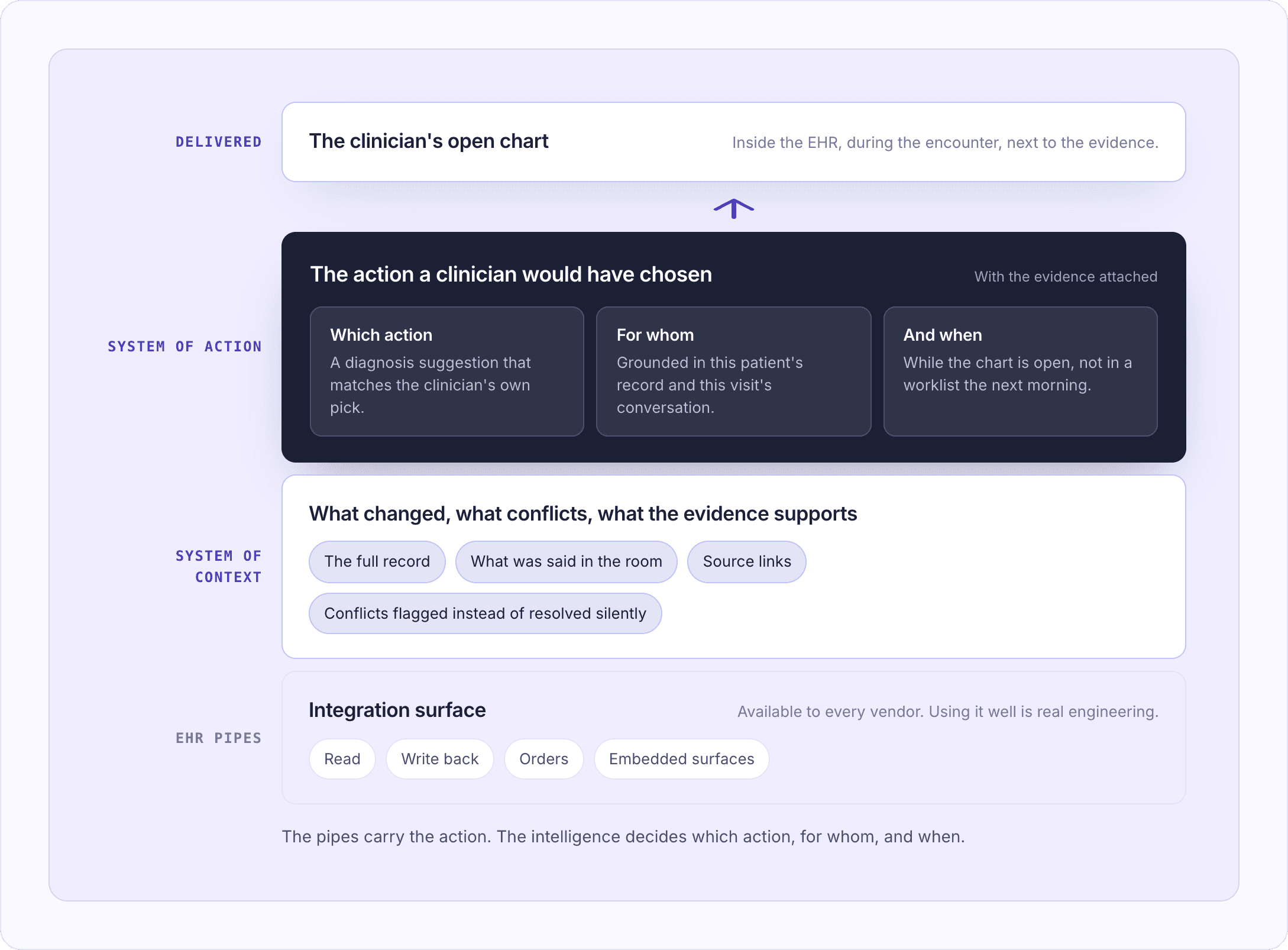
Every vendor connects to the EHR. The pipes themselves are hard. Healthcare data is fragmented, the interfaces are constrained, and moving data through them correctly and at scale is engineering that Ambience does well today. But the pipes alone do not make a system of action. The pipes carry the action. Clinical intelligence decides which action, for whom, and when.
What separates vendors is whether the suggested action is the one the clinician would have chosen. A diagnosis suggestion that matches the clinician’s own pick. A note so high quality that clinicians keep using it and it positively impacts downstream care. An order that appears while the chart is open, not in a worklist the next morning.
That precision comes from three places. Every suggested action starts from the system of context, so it reflects what changed, what conflicts, and what the evidence supports. It is grounded in the present visit, blending what was said in the room with what the chart says; this matters most when the clinician is resolving conflicts in the history, where acting on stale context would be wrong. And it is shown where it can be judged: the clinician sees the evidence next to the suggested action, inside the workflow, during the encounter.
Action requires governance
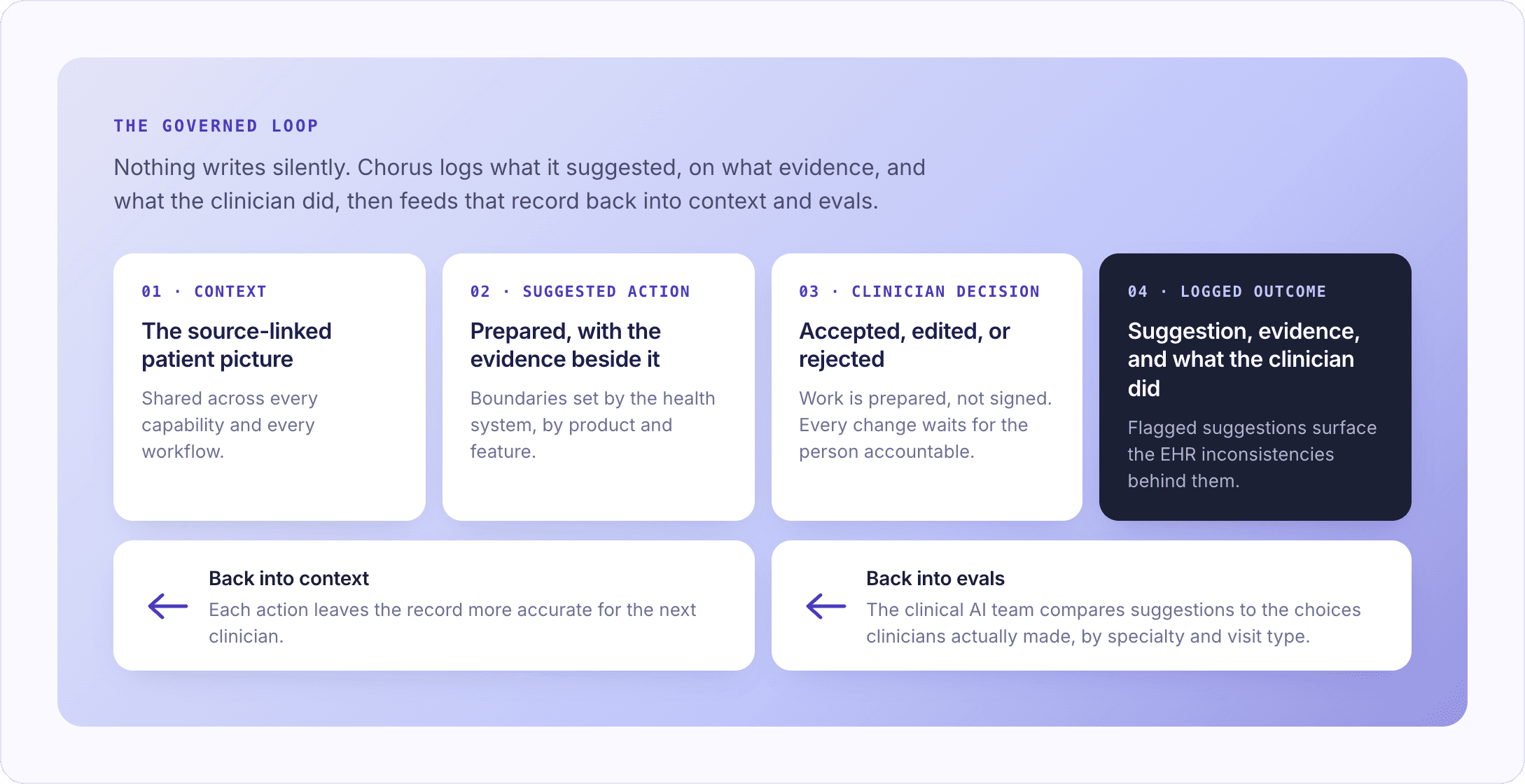
Errors in a patient’s record carry forward into future care and multiply when systems operate at scale. Chorus prepares work for the accountable clinician’s review and signature, and health systems control which actions are enabled by product, feature, and department. Our clinical AI team evaluates each action type against actual clinician choices and reviews the differences across specialties and visit types. Chorus logs every suggestion, its supporting evidence, and the clinician’s response, so errors can be traced and each action improves the next.
Clinical AI needs a shared foundation
Every health system will add more AI over the next few years: agents that reconcile medication lists, triage inbox messages, draft referrals, follow up with patients, and flag deteriorating inpatients. Each one will need to understand the patient and act on the record. The question is whether each comes with its own picture of the patient, its own way of writing to the chart, and its own review process, or whether they share one.
Shared, every new capability starts from the same understanding, acts through the same governed path, and is measured by the same loop, with a clinician in front of every change.
Ambience Chorus is the shared AI infrastructure for healthcare. Its system of context creates a trusted, source-linked understanding of the patient. Its system of action uses that understanding and the clinician’s own guidance to perform governed work inside the EHR.
Better models alone will not close the million miles to better care. Infrastructure that understands, acts, and improves with every encounter will.