Product
Written by
Ambience Healthcare
Read time
6
min read
Posted on

The biggest constraint of healthcare AI is no longer model intelligence. It is whether that intelligence can be put to work inside a health system to improve care.
Frontier models have improved at extraordinary speed. Yet inside the average health system, much of the work still looks remarkably similar to the pre-AI era.
At Ambience, we call that gap the millions of miles between better models and better care.
Creating a compelling AI demo is increasingly easy. Closing the gap is not. Before AI can reliably improve clinical workflows, it has to understand the patient: what has changed, what matters now, and which evidence supports the task at hand.
Today, we're announcing Ambience Chorus, the shared AI infrastructure that powers every Ambience product. Chorus brings together a system of context that builds and maintains a trusted understanding of the patient, and a system of action that puts that understanding to work inside clinical workflows.
AI must understand the patient
Dr. Amy Merlino, Cleveland Clinic's Chief Health Information Officer, describes the standard:
"Typically, medical residents begin drafting the patient note, and I would expect them to review a patient's chart first. Before they enter the room, it's crucial for them to understand the patient's history, the conditions we're managing, what medications they're on, recent test results, and what the rest of the care team has already said. Why would we accept a lower standard from AI?
AI listening to a conversation knows what was said in the exam room. It does not know what changed since the last visit, which medications were prescribed but never taken, or which facts buried deep in years of history could affect today's visit.
Deep chart context is a clinical requirement. AI needs to follow clinical threads, weigh the evidence, and know when to resolve a contradiction, or when to ask for help.
Shallow context is dangerous because it can make an incomplete answer look informed. For example, a signed radiation-treatment order conflicted with an appended physician note containing patient-specific instructions. A nurse reconciled the physician's intent, but an AI given only one source would have been confidently wrong.
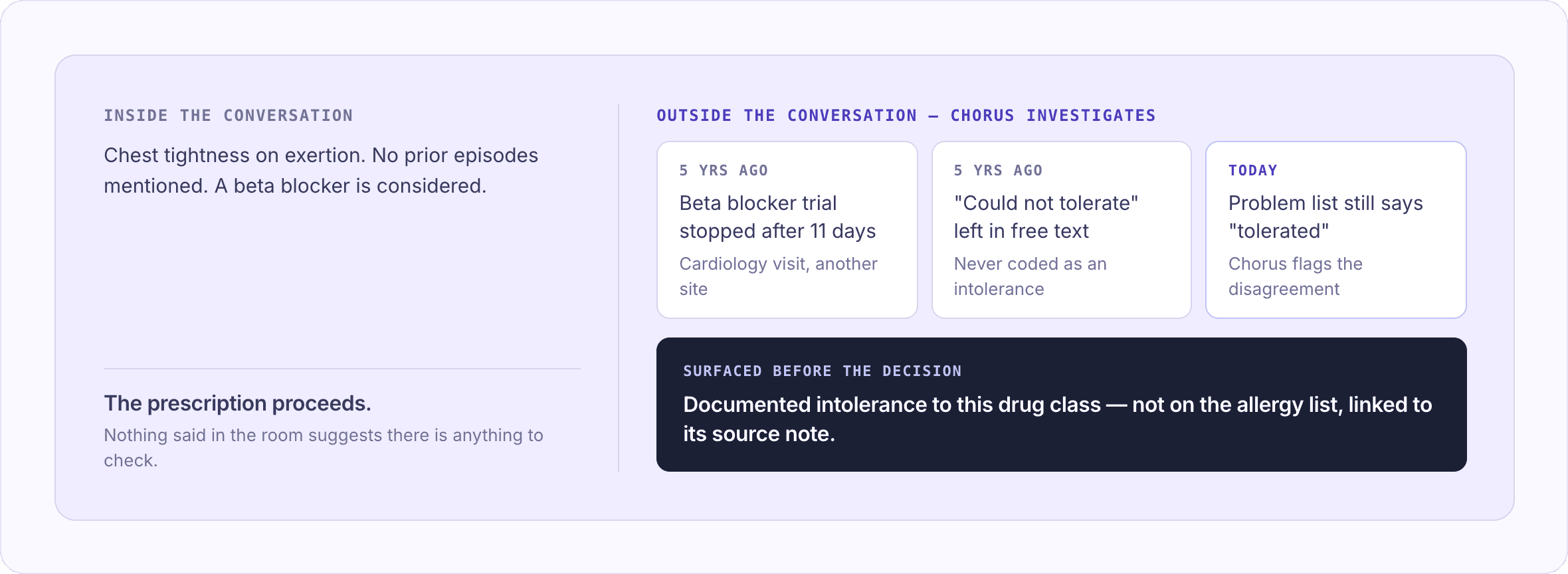
What a system of context has to do
Chorus maintains a shared understanding of the patient across Ambience capabilities. Access to the chart is only the starting point. Our system of context navigates the record, reconciles the chart into a source-linked understanding, and keeps that understanding current across workflows. Let’s break that down:
1. Navigate the record, not just retrieve it
Chorus works across notes, medications, labs, admissions, and diagnostic reports to follow clinical threads over time, distinguishes new developments from established history, and surfaces the evidence relevant to the task. It does not simply pass along the latest note or dump the entire chart into a model.
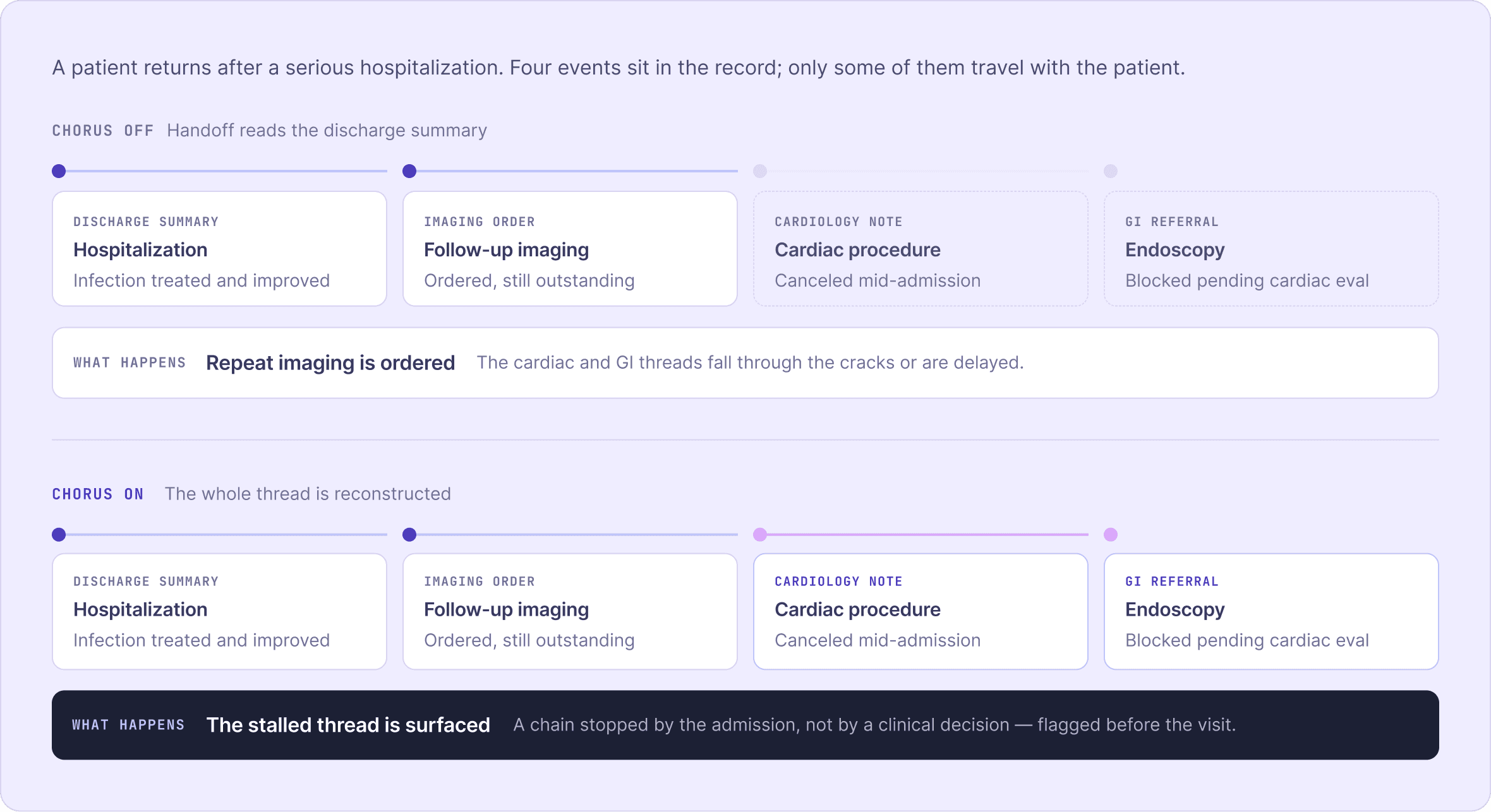
2. Create one shared, source-linked patient understanding
When the record conflicts with itself, Chorus reasons across the source, timelines, and related clinical evidence. It resolves what the evidence supports, surfaces what remains uncertain, and gives every Ambience capability the context it needs so each works from a consistent understanding of the chart rather than interpreting it independently.
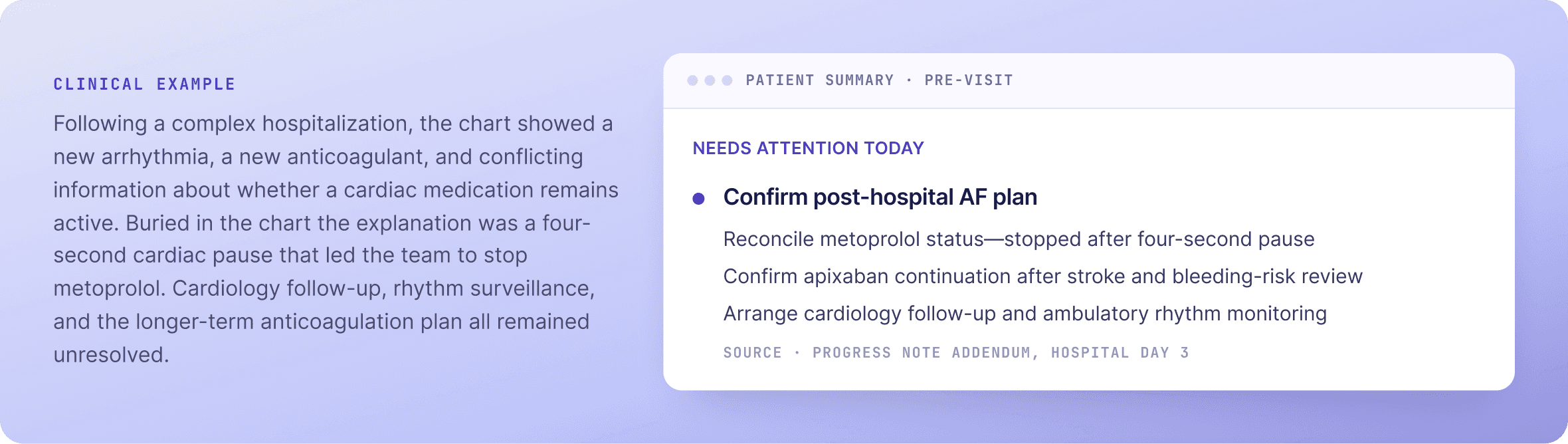
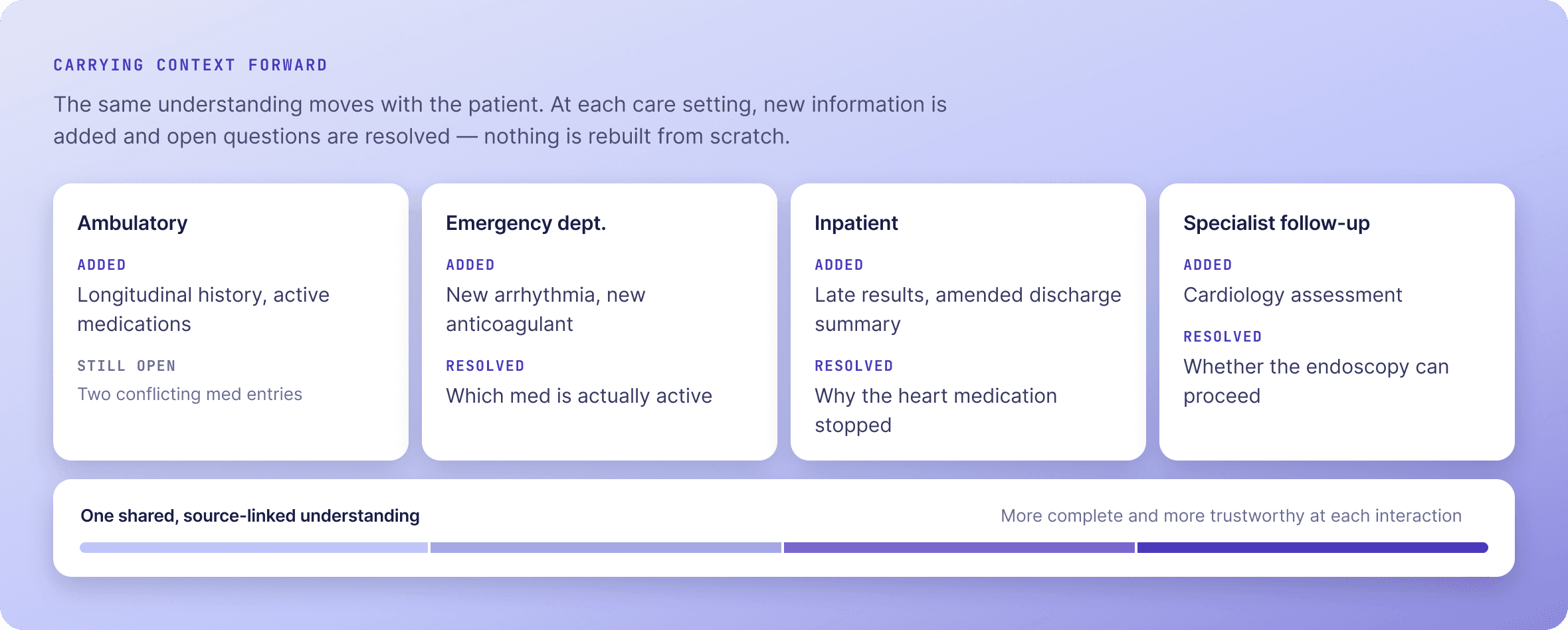
3. Carry context forward
Healthcare has spent decades trying to make data follow the patient. But continuity requires more than moving data: it requires a source-linked understanding that follows the patient across care settings and becomes more complete with each interaction.
Chorus and your EHR: Two systems serving different needs
The EHR was built to be the system of record. It preserves the observations, decisions, orders, results, and documentation that many people produce over time—and it does that job well. But for AI, that record is large, fragmented, and may contain information that is contradictory or irrelevant to the task at hand.
AI needs a current, clinically coherent understanding of the patient, tailored to the task and traceable to the chart. Without shared infrastructure, AI does not scale. Every new capability must reread years of history, process more information than it needs, and resolve the same conflicts from scratch.
As AI capabilities proliferate, health systems need a shared system of context between the EHR and the AI working across it: a working memory that retrieves what matters, stays current as the record changes, and can be reused across workflows.
That is the role of Chorus. The EHR remains the authoritative record. Chorus builds on it, turning the longitudinal chart into a shared, task-ready, source-linked understanding of the patient that every Ambience capability can use.
The next AI decision is architectural
For CIOs, CMIOs, and health system leaders, the question is no longer only which model is smartest or which application can automate a task.
It is whether every new capability will add another integration, another interpretation of the patient, and another system to govern — or whether each new capability will strength a shared foundation.
With Chorus, every capability starts from and strengthens the same foundation.
Better models alone will not close the million miles to better care.
Ambience Chorus is the shared AI infrastructure for healthcare. Its system of context creates a continuously updated, source-linked understanding of the patient that can follow them across care.
In Part 2, we'll show how Chorus's system of action turns that understanding into safe, useful work inside clinical workflows.